 Phuong Le
Falling Forwards
It was cold. My fingers were freezing, my teeth chattered, and the sour, stony gray that seeped through the window of the ice rink did nothing to help with my mood. The crisp smell of indoor ice called to me. As I sat, huddled against a metal bench, I looked yearningly towards the rink. If I could go back that day, I would have taken everything back.
I remember my initial excitement. I had finally landed my axel jump. For a solid minute, I stood in the middle of the ice rink, disbelieving and shocked. People skated by as they always had, but I took no notice of them. Too many times had I tumbled, too many times had I fallen, to even hope this day would come. But the kind ice forgave me, my legs obeyed me on that dreary afternoon day, and I had finally landed my axel.
In fear of losing it, I jumped over and over, pouring all my energy into every takeoff and every landing. Every time, my blades bit smoothly into the ice, my feet swung smoothly into the air, my arms pulled smoothly inwards, and my feet landed smoothly beneath me. I felt the rush of wind blowing through my hair as I lived the exhilarating thrill of landing a jump which took months to learn. It was as if the ice smiled up at me, congratulating me on my achievement. With each landing, I felt the eyes of my coach on me, stony yet smiling, and I was compelled to prove to him that I could do it once more.
I was confident in myself when, without warning, I felt myself crashing into the ground. My knee hit the surface and I came sliding across the ice. As I skidded to a stop, I saw my coach watching. I took a breath, picked myself up, and brushed myself off. There was no time to lose.
I forced myself to try again, moving faster, more determined. With each jump, my limbs stiffened, fatigue settling deeper into my bones. My breath came in quick, shallow bursts, barely enough to keep me going. I had lost sight of my surroundings. I could not tell whether I threw myself up or down; I could not distinguish front from back. I launched myself in whichever direction I could, hoping chance would help me make it. With each fall, I felt the eyes of my coach on me, quietly judging, urging me to do better. After countless attempts, I landed a few times—barely, teetering on the edge of collapse. The pride from my first successes faded quickly.
I skated away, angry at myself and the world. I sprinted desperately by couples holding hands, around little girls in woolen hats, through crowds of friends laughing, and past parents teaching their kids to skate, my feet pushing down on the ice one after another. I skated along the edge of the wall, around a corner, and back the other way. The wind slid its icy fingers through my hair as I skated away, streaming past my watering eyes as I rounded a corner. My feet flew over ice in a desperate escape from some unknown monster, my hair whipped across my face, and the dismal clouds spread their misery to me through a sad, solitary window. Slowly yet surely, I felt my axel slipping further and further from my grasp. What was I doing wrong?
From the other end of the rink, my coach quietly watched me position and gather myself, then jump. He quietly watched, and I slammed into the ground. He saw my knee thud dully against the ice and heard my pained cry of frustration. I resolved to try again.
“Stop.” Gasping for breath, I looked up to see my coach standing over me. “You aren’t making any progress by practicing like this. Get some water.” I stared mutely as he skated away. His stern tone told me to obey. Slowly, I breathed and clambered back up. I was about to do as he said when something stopped me, and I hesitated, looking back at the ice. In front of me, the ice—the cold, unyielding surface—stared back like a silent promise. I swallowed hard. It was as if the world had come to a standstill, holding its breath, waiting for me to make a choice that seemed predetermined. When my feet finally moved, I found an invisible force pulling them back to my starting position instead of away. I did not want to admit my failure. Inside, I was still certain that the more I tried, the more I would succeed. And I needed to believe it: that I still had one more chance to prove myself. I would not admit my failure; not here, not now. Not ever.
My knees bent slowly, unwillingly, as if merely preparing for the jump was impossible. My arms, heavy and weak, felt like lead as I pulled them back, the motion slower than it should have been. No, I told myself, This isn’t the time for hesitation. There was no more time for thought. I threw myself into the air, hoping I would guide myself in the right direction.
But something was wrong. Terribly wrong.
Suspended in mid-air, I saw my feet, meant to tightly hug one another, flying out exposed in the sharp cold air. Out of the corner of my eye, I saw my arms far out beside me, flailing helplessly in empty space. Below me, I saw my skates suspended in mid air, and beneath them, the intense white ice. But beyond myself, I saw my coach. His gaze locked on mine for that split of a second. In that moment, I saw not pride, but heavy disappointment in his eyes. I was wrong. I was so terribly wrong. His words echoed in my head, bouncing side to side, shaking me from within. Stop. He knew from the beginning, as I finally knew, that this jump could only end in one way. Although I wanted to take it back, the time I had to control my body was over.
I had nothing to do but wait and fall.
I felt a sudden, sharp pull in my knee. My blade came crashing down with no control of where it was going. I could feel my knee twisting at an impossible angle before a sickening snap swept through my body and I crumbled. My vision narrowed as the pain exploded around me. For a moment, everything went quiet except for the harsh, shallow breaths escaping my lungs.
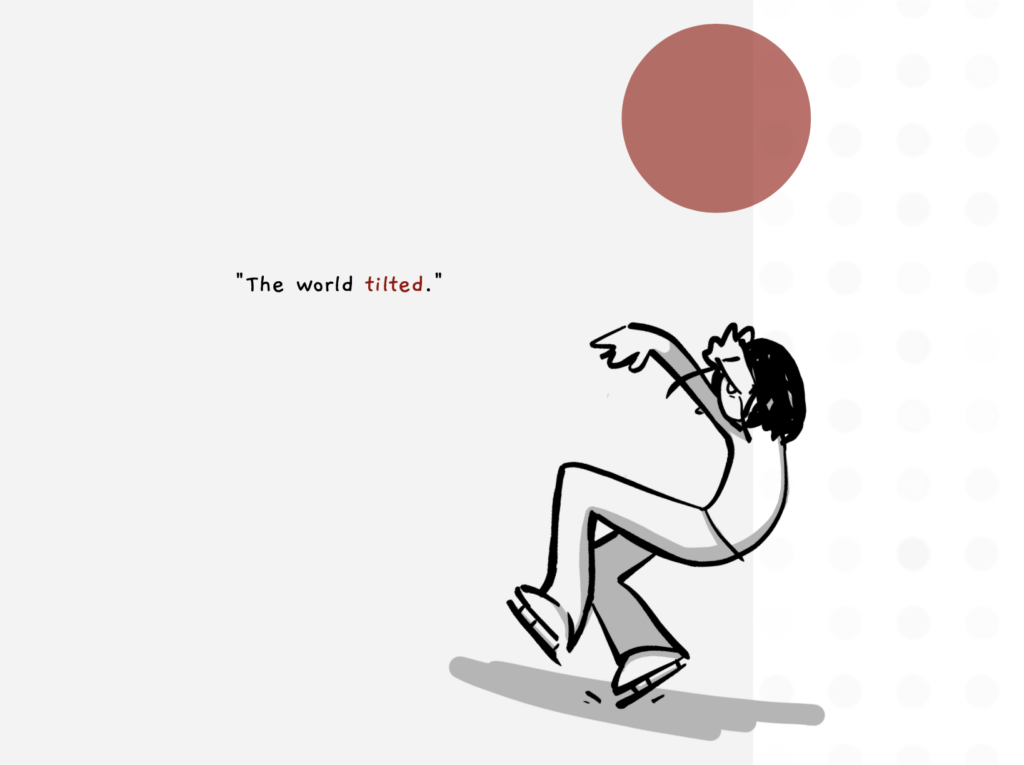
The world tilted. I pushed myself onto my hands, my breath ragged, my knee screaming in protest. I knew what this would lead to. Weeks off ice. All my efforts would be lost. Choking, I stumbled to my feet, trying to ignore the pain, telling myself I was fine. But my legs were useless against the icy enemy, cold and unforgiving. I took a few shaky steps before collapsing.
Tears fought to escape my eyes. Sharp breaths were forced in, and then out of my mouth, while my little world spun around me in an impossible haze. I expected the urge to cry to leave as the pain subsided to a steady ache. Instead, it surged through my brain, coursing within my veins, sending a message to every cell in my body of the shame of what I had done.
Through half-closed eyes, I made out a pair of dark, sleek skates, standing in stark contrast against the blinding and cold ice. It was my coach. I hung my head in embarrassment, my gaze unable to meet the eyes in which I had always sought approval.
“Look what you’ve done,” he said. “This is what happens when you don’t listen. This is what happens when you don’t do as I say.” I nodded, shaking, and stared at the ice in front of me, my gloved hands clenched in a fist. My coach sighed.
“Look at me.” I reluctantly lifted my gaze and shifted it to his eyes, preparing for the worst. Instead, within those eyes I saw not anger, nor frustration, but a simple disappointment.
A single tear finally found its way down my cheek.
I remember my initial excitement, desperation, and foolishness, followed by the painful consequences. I lost weeks of skating. Instead of gaining pride from my coach, I hurled it away with all my might. I had believed persistence alone led to success. That day, I learned otherwise. After my ignorance, I lost my axel when I could have just taken a break. I know I am lucky to have a second chance as I heal. Though my flaws will always echo in my mind, I promise myself that with every opportunity I have, I will acknowledge them. I will embrace them. It is the only way I can avoid what happened on that dreary afternoon: I will not push myself when I have nothing to gain and everything to lose. As I enter the rink, the ice smiles at me once again.